


Treatments:
Understanding ED and its possible impact on your life and relationships is an important part of treatment. Your doctor may recommend a combination of physical and psychological approaches. In the past, treatment focused mainly on the physical aspects of ED. Today, psychological and emotional factors are also recognised as important. Approaches that include psychological support or counselling can be more effective than treating physical symptoms alone. They may also be helpful for single patients or when the partner is not directly involved. If you are in a committed relationship, treatment may work better when your partner understands the condition, agrees with the treatment approach, and you are able to talk about it openly. Treatment is tailored to your individual circumstances. What works for one person may not be appropriate for another. If you have other medical conditions that may be related to ED, your doctor may refer you to a specialist for further assessment and management.
Lifestyle advice
Improving your overall health can help improve ED symptoms. Your doctor may advise you to:
Depending on your situation, your doctor may also suggest changes to your diet. In general, a varied diet that is low in sugar, salt, and saturated fats is recommended. Always discuss major dietary changes with your doctor, especially if you have other health conditions.
Phosphodiesterase type 5 inhibitors (PDE5Is) are a group of medicines used to treat ED. They work by relaxing smooth muscle in the blood vessels of the penis to increase blood flow. They do not cause an erection on their own; sexual stimulation is still required.
There are four commonly used PDE5Is:
- Sildenafil
- Tadalafil
- Vardenafil
- Avanafil
PDE5Is are among the most frequently prescribed treatments for ED. Several PDE5Is can be similarly effective. The most suitable choice for you depends on how often you wish to have sexual activity, how quickly you want the medicine to work, how long you want the effect to last, and how you tolerate side effects.
Because PDE5Is are widely used, counterfeit tablets are also sold in some places. These unregulated products may be unsafe. Always speak with your doctor or another qualified healthcare professional before using or buying medication for ED.
Sildenafil
Sildenafil is available as tablets, typically in doses of 25, 50, and 100 mg. The dose can be adjusted according to your needs and your doctor’s advice. The effects are usually felt 30–60 minutes after taking the tablet and may last for up to about 12 hours. A very fatty meal shortly before taking sildenafil may delay or reduce its effect.
Tadalafil
Tadalafil is available as tablets in doses of 5, 10, and 20 mg. The dose can be adjusted according to your needs. You may start to notice an effect about 30 minutes after taking it, with maximum effect often around 2 hours. The effect may last for up to about 36 hours.
Unlike some other PDE5Is, food does not significantly affect how tadalafil works. A low daily dose of tadalafil (5 mg) has also been approved as a treatment for urinary symptoms related to benign prostatic enlargement, with or without ED. Your doctor may consider daily tadalafil if you have both ED and lower urinary tract symptoms.
Vardenafil
Vardenafil is available as a tablet or as an orodispersible (dissolvable) tablet, usually in doses of 5, 10, and 20 mg. The dose can be adjusted as needed. The effect typically starts within about 30 minutes. A very fatty meal shortly before taking vardenafil may delay or reduce its effect.
Avanafil
Avanafil is a more recently introduced PDE5I, available in doses such as 50, 100, and 200 mg. The dose can be adjusted according to your needs and tolerability. The effect may be noticed from about 15–30 minutes after taking the tablet. Taking avanafil with food can delay its onset of action.
What are topical therapies?
Topical therapies are medicines applied to the skin or the urethral opening. Two specific alprostadil formulations have been developed for topical use:
- A small pellet placed into the urethra (intraurethral alprostadil)
- A cream applied to the external opening of the urethra at the tip of the penis
When should I consider topical therapies?
Alprostadil is a well-known medicine for treating ED. Topical preparations are often considered a second-line option, but in some situations they may be used as a first-line treatment. A potential advantage of alprostadil cream is that side effects are usually local and there are few interactions with other medicines (such as some blood pressure medicines or blood thinners).
How do topical therapies work?
Alprostadil is absorbed through the urethra and relaxes smooth muscle in the penile blood vessels, increasing blood flow. The cream contains a permeation enhancer to help the medicine enter the tissue. Its mechanism of action is similar to intraurethral alprostadil.
When are topical therapies not recommended?
You should not use alprostadil if you are allergic to it or if you have certain medical conditions, such as:
- Sickle cell anaemia or sickle cell trait
- Leukaemia
- A tumour of the bone marrow (multiple myeloma)
- A markedly curved or deformed penis
- Penile fibrosis or Peyronie’s disease
- A penile implant (depending on your doctor’s advice)
Your doctor can advise whether these treatments are appropriate for you.
What are the side effects?
Common side effects of topical therapies include local penile pain and dizziness, sometimes with a drop in blood pressure. In some cases, urethral bleeding or urinary tract infection can occur. Penile fibrosis and priapism (a prolonged, often painful erection) are uncommon.
Topical alprostadil cream mainly causes local effects such as penile redness, burning, or discomfort. General (systemic) side effects are uncommon.
To make sure alprostadil is safe for you, tell your doctor if you have:
- A history of blood clots
- Heart disease or high blood pressure
- A bleeding or blood-clotting disorder
- A blood-borne infection such as hepatitis or HIV
Using a condom can help reduce the chance of exposing your partner to the medicine.
What is shockwave therapy?
Extracorporeal Shockwave Therapy (ESWT) is a therapy in pulses of focussed shock waves with very low intensity is directed at the penis to improve erectile function. It consists of several sessions, and it can be repeated if necessary.
ESWT is being researched as a new treatment option for ED. It is not a standard treatment option. Specific ESWT devices are necessary to treat ED. Discuss with your doctor if ESWT is the proper treatment for you and is available in your hospital.
Interesting fact
Shockwave therapy is also used to treat kidney stones and conditions like arthritis. In these cases, the intensity of the shockwaves is higher.
When should I consider ESWT?
If you have mild ED and you cannot or do not want to take PDE5Is, your doctor may recommend ESWT. Keep in mind that ESWT is currently no standard option for the treatment of ED.
How does it work?
ESWT causes minor damage to the penile tissue. During the healing process, new blood vessels are formed, which increase the blood flow to the penis. This may result in an improved ability to get and maintain an erection.
What are intracavernous injections?
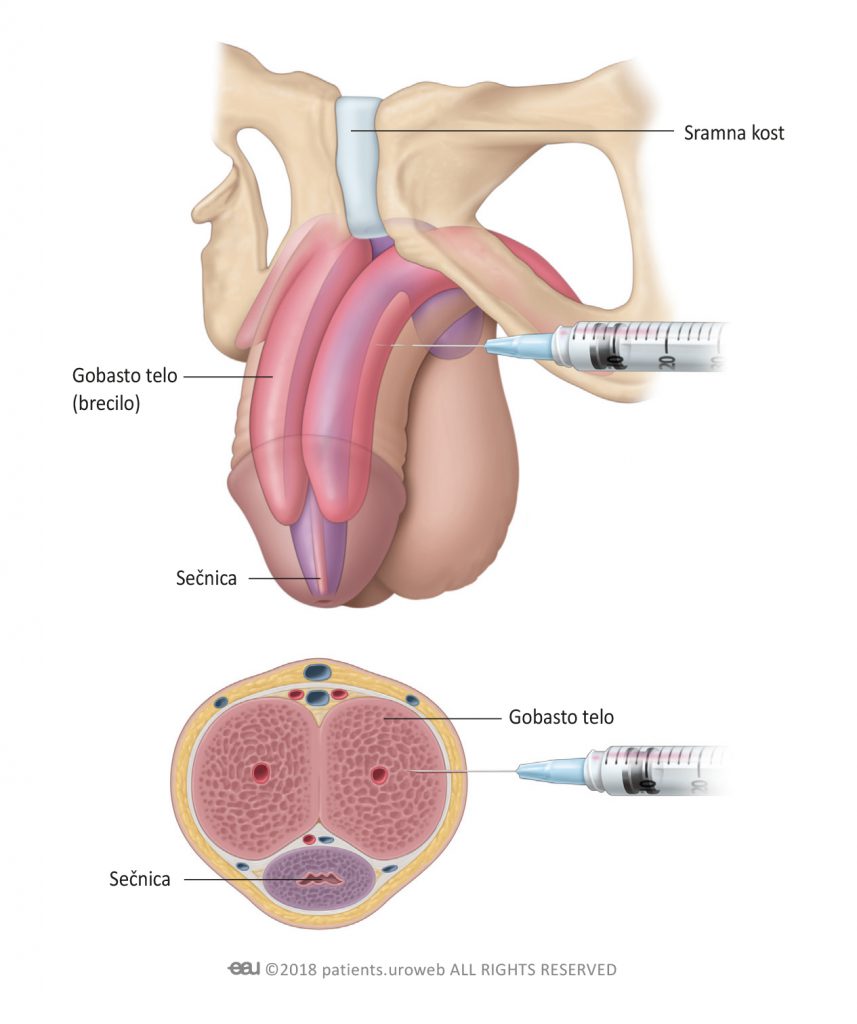
Intracavernous injections are a treatment option for ED where you inject drugs into the spongy tissue in the penis to open the blood vessels.
When should I consider intracavernous injections?
Intracavernous injections would be a treatment option if previous treatments such as lifestyle changes or PDE5Is were unsuccessful. Although many men will be scared by the idea of placing a needle into their penis, most men who choose injection therapy quickly realize that the benefits of the injection far outweigh a tiny pinprick.
How do intracavernous injections work?
The drugs in intracavernous injections relax smooth muscle in the vessels in the penis to increase blood flow. This results in an erection 10-15 minutes after the injection, even without sexual stimulation.
The most common drug used for intracavernous injections is alprostadil. In some cases, your doctor may recommend a combination of drugs to improve the effectiveness or reduce the side effects. Common medications include papaverine, phentolamine, vaso-active intestinal peptide, atropine, and forskolin. Dosages may vary and can be adjusted as needed. Keep in mind that not all drugs are available in all countries.
How do I perform an intracavernous injection?
You might receive in-office training from your urologist to learn how to inject yourself. In some cases, your partner may receive training as well. During the training, the urologist will also discuss the correct dosage with you.
The location of the injection is essential. Ensure to inject at the base of the penis, and between 2 and 4 ‘o clock, or 8 to 10 ‘o clock positions to not damage the urethra or the nerves and blood vessels in the penis. Then, gently apply pressure for 2-5 minutes at the injection site to prevent bruises. If the correct dosage is injected, you will have an erection within 10-15 minutes.
When are intracavernous injections not recommended?
You should not use intracavernous injections when you are hypersensitive to any ingredients in the drug, when you are at risk for priapism, or when you take medications to prevent blood clotting. Your urologist can give your more in-depth information on these contraindications and discuss your situation.
What are the side effects?
The most common side effects of injections are a pain in the penis during erection. This happens in about 1 out of 10 injections, and the pain usually stops when the erection ends. Another minor side effect is bruising at the injection site.
The most severe side effect is priapism. This means that an erection lasts longer than 4 hours and is painful. Priapism may damage the smooth muscle cells in the penile vessels and can worsen ED. It is essential to contact your doctor if you have an erection that lasts longer than 2-3 hours. Generally, priapism can be treated effectively with the injection of an antidote.
What is a vacuum erection device?
The vacuum erection device (VED), is a cylinder-shaped device that comes with a rubber or silicon constrictive ring that tightens around the penis. A VED makes it possible to get and maintain an erection.
When should I consider a VED?
You should consider a VED if PDE5Is are not effective. A VED is also an alternative treatment option if you cannot use PDE5Is or if you do not want to take medication for ED.
How does a VED work?
By placing the cylinder over your penis, you create a vacuum with a manual or an electronic pump that removes the air from the cylinder. This process draws blood into the penis so that it gets swollen and then erect.
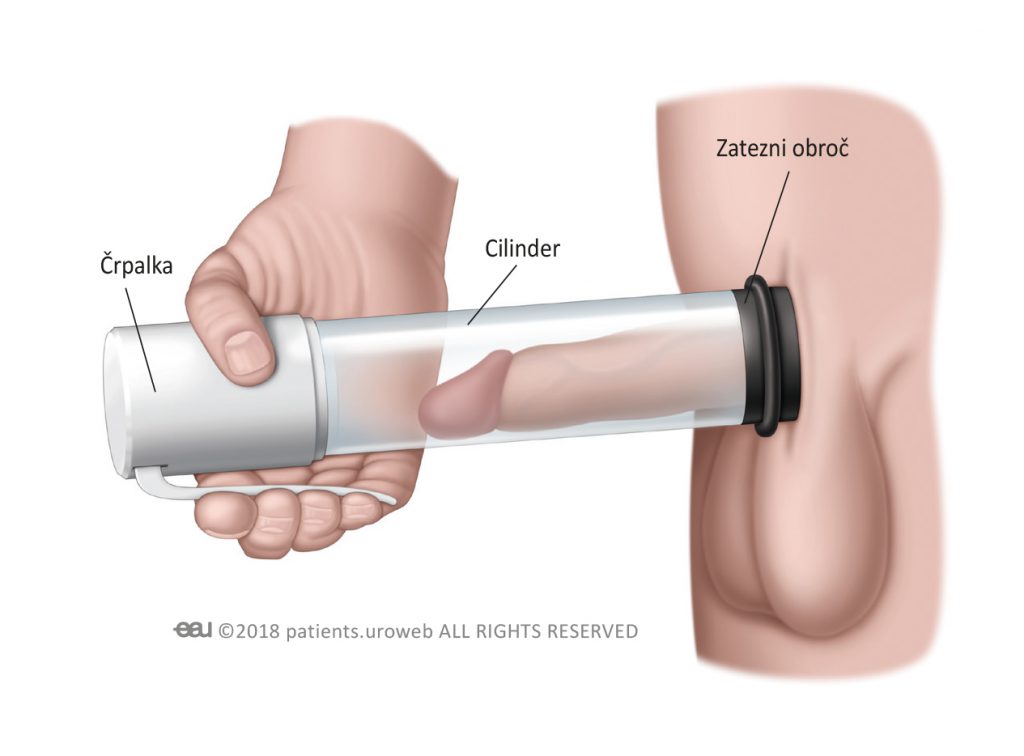
After removing the pump you need to place the rubber or silicone ring around the base of the penis, to keep an erection. Never leave the ring on for more than 30 minutes.
It is important to be aware that the blood drawn into the penis is dark in color. As a result, your penis feels colder to the touch and looks slightly blue once the band is in place. Some people do not mind, but if this makes you or your partner uncomfortable, make sure to discuss your concern with each other, and your doctor.
It is very important to know that the ring should be removed after 30 minutes. The blood drawn into the penis is low in oxygen, and the lack of oxygen can damage the skin in the penis.
If you choose to use a constrictive ring without a VED, make sure that it is made of flexible material like silicone or rubber. Never use rigid materials such as steel or hard plastic because they may be difficult to remove.
When is the VED not recommended?
VEDs are not recommended if you take medication to prevent blood clotting, or if you have a bleeding disorder.
What are the side effects of VEDs?
VEDs can cause some discomfort, difficulty with ejaculation during orgasm, bruising of the skin of the penis, and numbness. Leaving the constrictive ring for more than 30 minutes can cause severe skin damage to the penis.
What is a penile implant?
A penile implant, also called a penile prosthesis, is a medical device that is surgically implanted into the erection chambers of the penis in case of severe ED.
When should I consider penile implant surgery?
A penile implant is an option if you have tried PDE5Is and intracavernous injections, and both had little effect on ED. It may also be recommended if you cannot use PDE5Is or the drugs in the injections. If you have tried PDE5Is and injections but are unhappy with the results and want a permanent solution, a penile implant may be an option.
How does a penile implant work?
There are two types of penile implants: semi-rigid, noninflatable implants and inflatable implants.
Semi-rigid implants consist of two bendable rods that are implanted in the erection chambers of the penis. They can be bent into position during sexual activity. With this type of implant, the penis is always semi-rigid, which may be difficult to conceal.
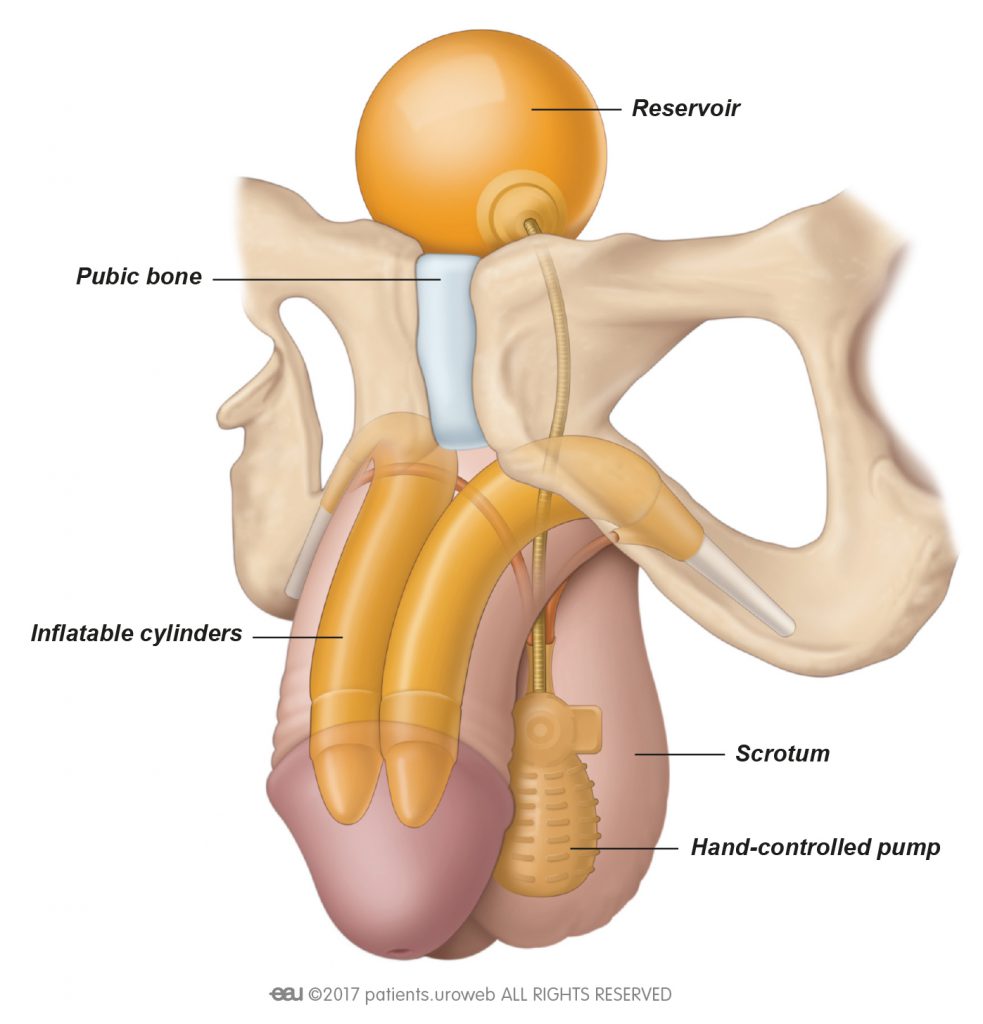
Inflatable penile implants are devices filled with fluid consisting of two inflatable cylinders placed in the erection chambers of the penis, a hand-controlled pump placed in the scrotum, and a reservoir that stores fluid when the penis is not erect. The device is inflated by squeezing the pump several times to move the fluid from the reservoir to the cylinders. Afterward, the pump is also used to move the fluid back to the reservoir (Fig. 1).
You need surgery for both types of implants. Both types of implants are placed entirely inside the body. Inflatable implants are used more often because they result in a more natural situation. In complicated cases, semi-rigid implants may be more suitable. Discuss the choice between the two implants with your urologist.
The procedure
For penile implant surgery, you will receive either general or spinal anesthesia. You will also get a urinary catheter, which can be removed the day after surgery. Once you are under anesthesia, the doctor will make a small incision either above the penis or between the penis and the scrotum. The incision exposes the erectile chambers, and the surgeon measures them to place a penile implant of the correct length.
Once the cylinders are in place, the reservoir is placed behind the abdominal wall, and the pump is placed in the scrotum between the testicles to conceal the pump.
Finally, all elements of the implant are connected, and the incision is sutured. The wounds are cleaned, and a compressive bandage is applied. Most surgeons choose to leave the penile implant inflated for one day. Some surgeons prefer to leave a drain which is then usually removed one day after the procedure.
How to prepare
Your doctor will advise you in detail about how to prepare for the procedure. You must not eat, drink, or smoke for 6 hours before surgery to prepare for the anesthesia. If you are taking any prescribed medication, discuss it with your doctor. You may need to stop taking it several days before surgery.
After the procedure
How long will it take me to get back to my daily activities?
Usually, you can leave the hospital the day after surgery when the compressive bandage has been removed, and your doctor has deflated the implant. You may experience pain or soreness and swelling of the penis and scrotum in the first few days and up to several weeks after surgery. This is normal and can be treated with analgesics and cold packs. In the first 2-3 days after surgery, there may be a small amount of discharge from the incision. There is no need to treat this because it usually stops on its own.
For 4-6 weeks after the surgery:
- Do not lift anything heavier than 5 kilograms
- Do not do any heavy exercise and avoid bike riding
- Do not take thermal baths or go to the sauna
- Discuss any prescribed medication with your doctor
Your doctor will schedule an appointment to inflate the implant for the first time. This is done once the swelling and soreness have gone, about 4-6 weeks after the procedure. After the appointment, you may start having sexual activity.
You should notify your urologist if:
- The swelling is severe or not improving
- You have a discharge of a large amount of fluid each day
- The pain gets worse or does not improve
- You notice increased redness or tenderness around the incision site
- You have a fever
Benefits
- Low rate of mechanical failure
- It is possible to inflate the device discreetly
- Inflatable implants are easy to conceal
- No risk of priapism
- Penile implants show high patient satisfaction in clinical experience, especially when patients and their partners are well informed about the procedure and what to expect.
